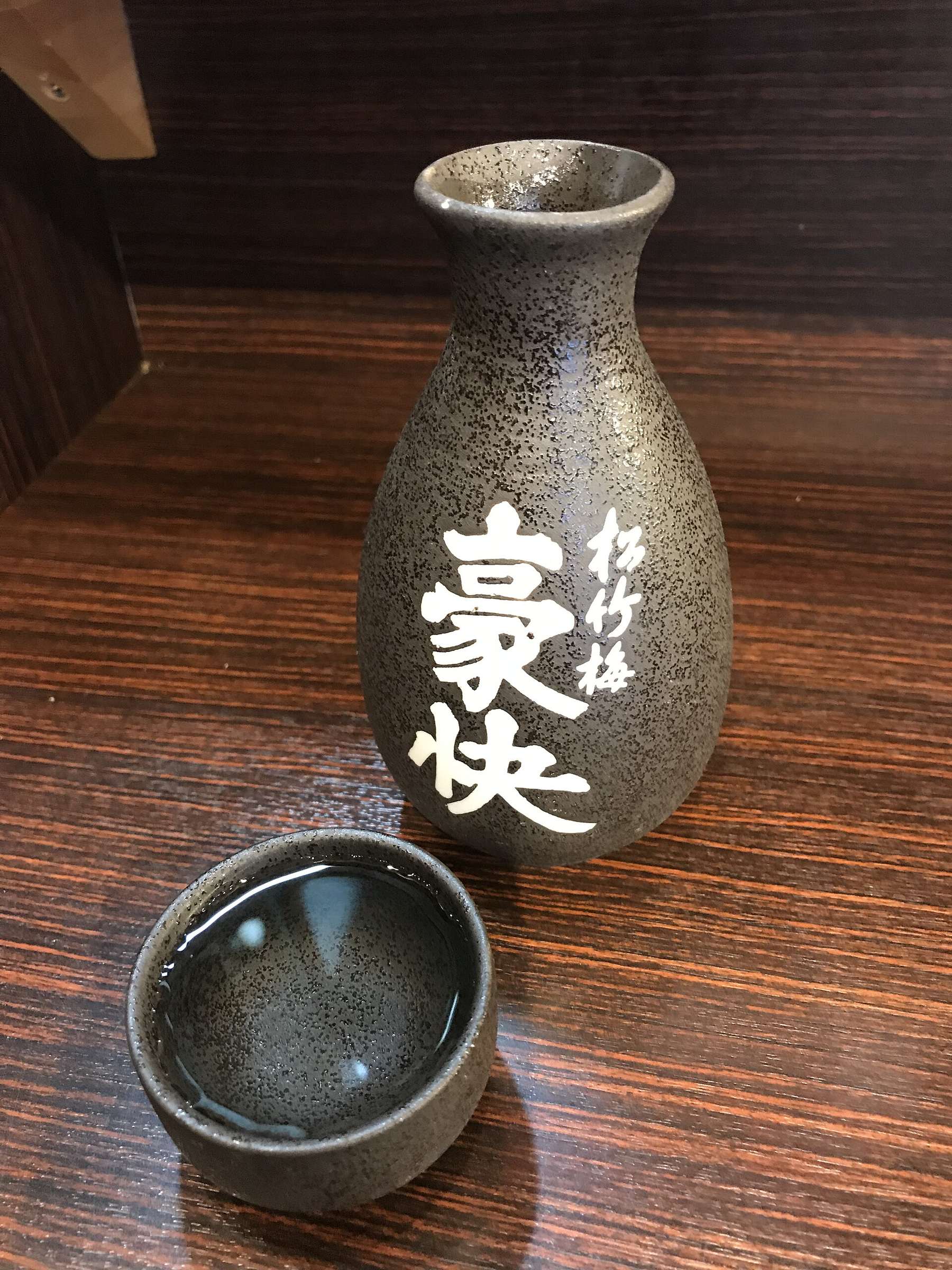
Order sake at a restaurant in this city and it often comes in one of two vessels. One is a small ceramic cup, frequently dark and speckled like the one in the photograph above, set down next to a tokkuri. The other is whatever glass the bar had clean. Neither choice usually gets made on purpose, and the vessel changes what reaches your nose and where the sake lands in your mouth more than most people would guess.
None of this is an argument against the ochoko. It does some things nothing else does. It also costs you some things, and the costs are largest with the kind of bottle people tend to save for a special night.
The cup the professionals use
When Japanese brewers and judges evaluate sake, the cup on the table is a kiki-choko. The Society for Nada Sake Research, whose glossary is translated by the brewer Philip Harper, describes it as usually white porcelain, holding about 200 ml when full, with two concentric rings of dark cobalt blue at the bottom. The pattern is called ja-no-me, snake's eye. The blue is there for judging clarity and the white for judging colour, and the cups in one evaluation have to be uniform in colour, shape, size and weight so that no sake gets an advantage from its container. When tasters want to judge a sake without being swayed by its colour, the same glossary says, they switch to an amber glass instead.
Two things follow from that. The first is that colour and haze carry real information, enough that the trade built a cup around reading them. The second is that a dark glazed ochoko throws all of that away. You cannot see what is in the cup in the photograph above, and with a nigori like the Momokawa Pearl that won our June flight, the look of the pour is half of what the bottle is.
What a bowl does that a cup cannot
Aroma needs somewhere to collect. A small straight-sided cup filled near the brim has almost no air above the liquid, so whatever evaporates drifts off sideways before your nose gets to it. A wine glass filled a third of the way has a bowl of air over the sake and a rim that narrows over it.
The clearest picture of what that bowl does comes from wine. In 2015 Takahiro Arakawa, Kohji Mitsubayashi and colleagues published a study in the journal Analyst using what they called a sniffer-camera, an enzyme coated mesh that glows where ethanol vapour touches it. Over a wine glass of wine at 13°C, about 55°F, the alcohol vapour formed a ring around the rim and stayed comparatively low in the centre. Warmer wine showed no ring, and neither did a straight glass or a cocktail glass. The authors' reading was that the shape lets you smell the wine's aroma through the middle of the glass without the alcohol getting in the way. We could not find the same experiment run on sake, so the result is a hint about sake and no more. It is a strong hint, though, since the six bottles in our June flight ran from 14.8 to 16 percent alcohol, and a bowl of air behaves the same whatever is underneath it.
The Japanese industry has reached the same place by taste. The Fine Sake Awards Japan has run since 2011 as a blind competition in which every entry is judged from a wine glass, and the organisers say it now draws around 300 sake from about 200 breweries. Their stated reason is that a wine glass shows aroma, colour and viscosity that traditional vessels hide, and that many Japanese drinkers were surprised to find sake tasting more graceful from one. It is worth knowing that Riedel's Japanese company is listed as a special supporter of the awards, alongside the Japan Sake and Shochu Makers Association as official supporter, so a glass maker has an interest in the conclusion, even though the judging itself is done blind.
Two glasses, and why the second one is wide
Riedel released a Daiginjo glass in 2000, tapered and oval, built to concentrate the fruit that a heavily milled ginjo is made for. According to SAKETIMES, which covered the launch, the company then spent about eight years from 2010 working on a second glass for junmai, and when it came out in April 2018 it went the other way. The bowl is broader and the opening wider, closer to a burgundy glass than a riesling one. Maximilian Riedel said the team began with a small narrow design and abandoned it.
The reasoning given at the launch is the useful part. Satoshi Kimijima, who runs the Yokohama sake shop Kimijimaya and was then executive vice president of the Japan Sommelier Association, said that plenty of people dislike the aroma of sake made from lightly polished rice, especially people new to sake, and that the wider glass makes it possible to enjoy the flavour while keeping that aroma in the background. He named drinkers who avoid kimoto and yamahai as the ones it suits. A narrow opening also narrows your mouth and lands the sake on one point of the tongue, while a wide one spreads it.
That is a description of our bottom two. Kurosawa Junmai Kimoto and Hatsumago are both kimoto junmai with rice milled to 65 and 60 percent, and they finished fifth and last on the score sheet at 3.5 and 2.0. The case already made in the post on serving temperature is that both should have been warm. The glassware argument points the same way from a different direction, since the style that suffers most in a narrow vessel is the one that came last. Our records note the temperature of that night and say nothing about the vessel, which is a gap worth closing before the next flight.
When the small cup is the right call
Warm sake is where the ochoko earns its place. The Japan Sake and Shochu Makers Association's service manual found warmed sake falling from 158°F to 95°F in about thirty five minutes in an ordinary room, which crosses most of the named bands for warm sake. Small pours from a tokkuri that is holding its heat keep each sip close to where you aimed it, and a thick ceramic cup keeps it there a little longer. For a rich junmai at nuru-kan, around 104°F, the cup is doing its job.
The practical split, then, follows the bottle. Anything sold on aroma, which means most ginjo and daiginjo, goes in an ordinary white wine glass filled a third of the way, and nothing about that requires buying a specialist glass. Earthy kimoto and yamahai go in the widest bowl you own if they are cold. Warm sake goes in small cups, refilled often. If you want to judge colour, use something white or clear. A blind tasting that is meant to be fair should give every bottle the same vessel, which is the same rule the kiki-choko enforces, and is described along with the rest of the evening in how a blind tasting works.
The ones we hear most
Is it better to drink sake from a wine glass or an ochoko?
For aromatic sake such as ginjo and daiginjo, a wine glass shows more of the aroma, which is why the Fine Sake Awards Japan, a blind competition held since 2011, is judged entirely from wine glasses. For warm sake, a small cup keeps each pour inside one temperature band for longer.
What is a kiki-choko?
The white porcelain tasting cup used in Japanese sake evaluation, holding about 200 ml when full, with two concentric cobalt rings at the bottom called ja-no-me, or snake's eye. The blue is for judging clarity and the white is for judging colour.
What sake glass does Riedel make?
Two. A Daiginjo glass released in 2000, tapered and built around fruity aroma, and a Junmai glass released in April 2018 after about eight years of development, with a broader bowl and a wider opening.
Which glass should I use for kimoto or yamahai sake?
Something with a wide opening. The case made at the Riedel Junmai glass launch was that a broad bowl tempers the earthy aromas of minimally polished sake that put some drinkers off, while spreading the sake across more of the tongue.
Written for Kasumi Club, a sake tasting and buying club in Washington, D.C. Every bottle we have poured, with its blind score and full specifications, is on the score sheet, and the terms are defined in the glossary.
Send us a bottle and about twenty people will tell you the truth.
Kasumi Club pours everything blind. Breweries and importers use us to test the D.C. market, and every bottle we pour gets a page with its score, whether it wins or not.
How it works for breweries