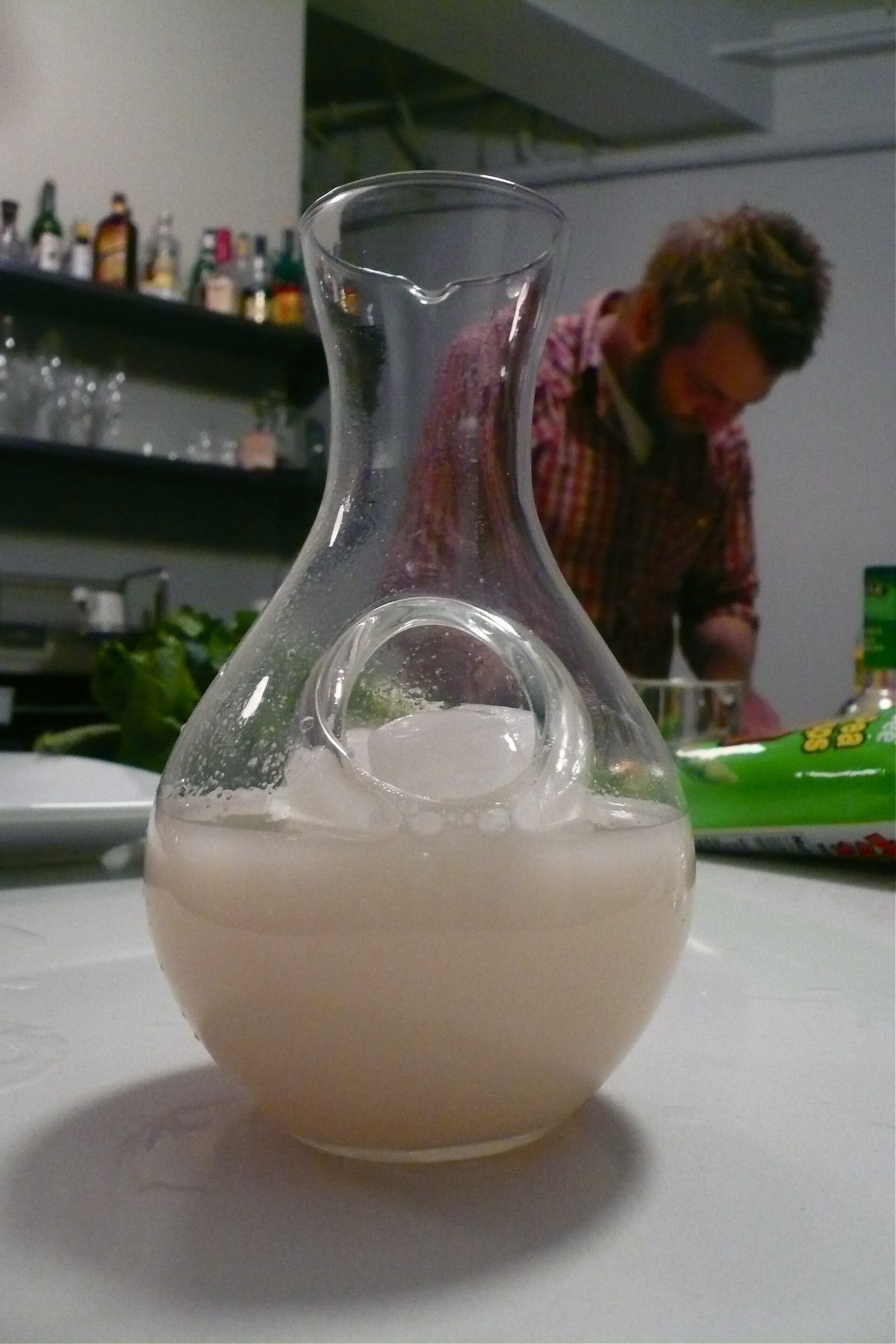
Three bottles are waiting in the apartment in Glover Park for Saturday, October 24. That is the date of the club's second blind tasting, and every bottle in it so far was sent to us by the people who make or import it. They are named here a few weeks early because anyone who puts a bottle in the post deserves to see their name in public before the night rather than after it. Knowing the names will not help anybody in the room. The bottles still go into numbered bags before anyone arrives, and nobody learns which glass held what until every card is in, the same way it worked in June and the way it is laid out in how a blind tasting works.
Everything below comes from what each producer or importer publishes about its own bottle. Tasting notes are left out on purpose, and so is any guess at a score. The room settles that, and the results go on the score sheet next to the six bottles from June.
Two bottles from Niigata
Richard Lay of Lanterna Distributors drove these over himself and left the box on the front step on September 22, with Carrie Becker of Niigata Sake Selections on the thread from their side. Niigata Sake Selections describes itself as a group of hand-selected breweries from Niigata Prefecture, where its own site says parts of the mountains get more than 30 feet of snow a year.
Kirinzan Classic comes from Kirinzan Shuzo in Aga, a brewery founded in 1843. The importer names Shuntaro Saito as the seventh generation of the founding family and Yoshiaki Hasegawa as toji. The importer's sheet lists the rice as Gohyakumangoku and Koshi-ibuki, milled to 65 percent, with soft water, a sake meter value of +6, acidity of 1.3 and 15 to 16 percent alcohol. If those last numbers mean nothing yet, the label guide explains what each one tells you. The name comes from the kirin, which the importer describes as a mythical creature something like a flying unicorn, believed to bring happiness and luck.
The word on this bottle worth pausing on is futsu-shu. That is the category for everything outside Japan's eight legally defined premium grades, and the importer's own classification page compares it to table wine. The same page puts the milling line for honjozo at 70 percent, and this rice went further than that, to 65. The sheet does not say why a bottle milled past that line is sold as ordinary sake, and we would rather leave the question open than invent an answer. Gohyakumangoku, for what it is worth, was bred at the Niigata experiment station in Nagaoka, as the piece on sake rice covers, so this is Niigata rice by origin in a Niigata bottle.
Yuki Otoko Yeti Nigori is from Aoki Shuzo in Shiozawa, in Minami-Uonuma, a brewery founded in 1717, and the importer names Takafumi Aoki as the twelfth generation of the founding family. Its name has the best story in the lineup. According to the importer, Yuki Otoko is the snow man of those mountains, drawn as a large hairy figure by Suzuki Bokushi in Hokuetsu Seppu, his early nineteenth-century account of life in snowy southern Niigata. Bokushi's son became the seventh generation of the brewery. In the legend the Yuki Otoko carries travellers' loads and guides them along mountain trails, and the brewery gives part of its proceeds to local rescue work for hikers.
On paper it is a junmai, so no distilled alcohol went in. The koji rice was milled to 65 percent and the rest to 70, all Gohyakumangoku, and the water comes from the brewery's own well, fed by an underground current that starts at Makihata-yama. The toji is Muneyoshi Higuchi. It is 13.5 percent alcohol, and the importer's instruction is to serve it chilled and shake it gently before opening. Nigori describes how a sake was filtered rather than what grade it is, which is how June's winner could be a nigori and a junmai ginjo at the same time. The Momokawa Pearl page goes into that.
Batch 7 from Vermont Sake
Vermont Sake brews in Monkton, Vermont, and calls itself the state's first sake brewery. Its own site describes the scale as nano, or maybe pico, and treats each batch as a separate experiment with ingredients and method. Andrew at Vermont Sake sent us Batch 7, and it has been waiting its turn longer than either Niigata bottle.
The brewery lists Batch 7 as a junmai made with Yamada Nishiki and Titan rice, thanking the Isbell family, whom it names elsewhere on the same page as the growers in Arkansas. It was fermented with the #9 sake yeast. The bottle is unfiltered, and the brewery says it comes out clear anyway because gravity and time settled the solids, so a little sediment may be resting at the bottom. Its process page describes a temperature-controlled, slow fermentation built up through several additions of water, koji and steamed rice, then gentle pressing and pasteurization twice, once after pressing and again after bottling.
Yamada Nishiki grown in Arkansas and brewed in Vermont is about as far from the usual story of that rice as a bottle can get. The last American bottle we poured blind was the one that won, and that has no bearing on how this one will do, since the bags do not know where anything came from either.
Getting a bottle into the flight
The lineup is still open. A bottle that reaches the club by Friday, October 16 goes into the October 24 flight, because the flight gets locked and photographed before the night. A later arrival rolls to the following tasting. Every bottle poured gets its real score out of 5 and a page of its own, whether it wins or finishes last, and whoever sent it gets the link the day it goes up.
Nothing is for sale at a tasting. Kasumi Club is an informal buying group, so if the room likes a bottle enough to want more of it, members pay in advance and order a case together through a licensed D.C. retailer, and the sender hears about it when that happens.
The ones we hear most
When is the next Kasumi Club blind tasting?
Saturday, October 24, 2026, in Glover Park, Washington, D.C. The lineup cutoff is Friday, October 16.
Which sakes are in the October flight?
So far Kirinzan Classic from Kirinzan Shuzo, Yuki Otoko Yeti Nigori from Aoki Shuzo, and Batch 7 from Vermont Sake. More may join if they arrive by the cutoff.
Why name the bottles before a blind tasting?
Knowing the lineup does not tell anyone which glass is which. The bottles still go into numbered bags before anyone arrives, and nobody sees a label until every score is in.
Does Kasumi Club sell the sake it pours?
No. The club is an informal buying group. If the room wants more of a bottle, members pay in advance and order a case together through a licensed D.C. retailer.
Written for Kasumi Club, a sake tasting and buying club in Washington, D.C. Every bottle we have poured, with its blind score and full specifications, is on the score sheet, and the terms are defined in the glossary.
Send us a bottle and about twenty people will tell you the truth.
Kasumi Club pours everything blind. Breweries and importers use us to test the D.C. market, and every bottle we pour gets a page with its score, whether it wins or not.
How it works for breweries