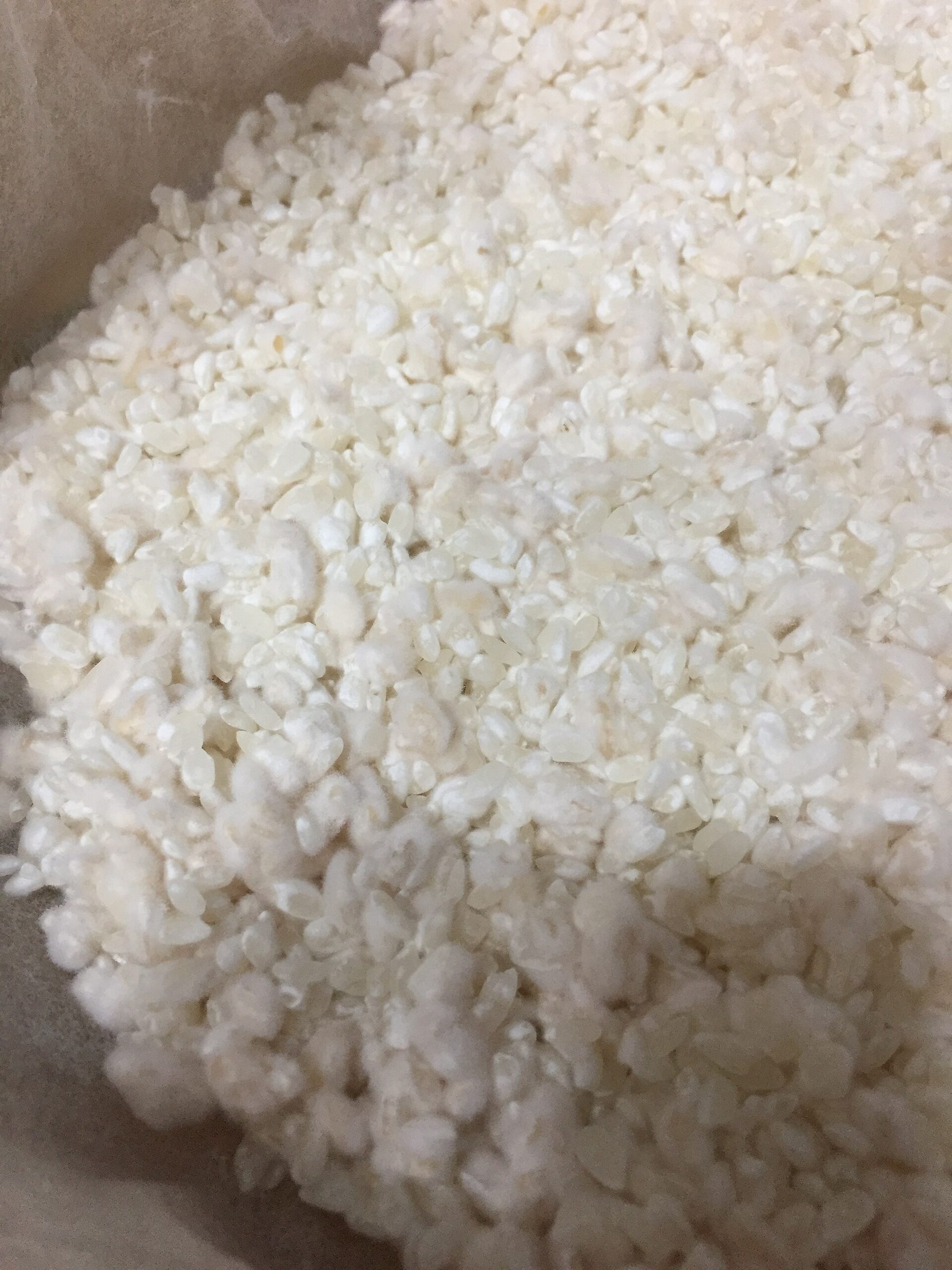
Every one of the six bottles we poured blind in June was made by a process with a hole in it. Beer gets mashed. Crushed malt steeps in hot water, the barley's own enzymes turn its starch into sugar, and the sweet liquid comes off the grain before yeast ever sees it. Sake skips that stage and puts nothing in its place, because the work happens inside the fermentation tank, done by a mould growing on a fifth of the rice.
That mould decides more about a bottle than almost anything else on the spec sheet, and it is the one variable none of our six labels mentions.
What the mould is doing to the grain
Yeast eats sugar. Grapes show up full of it, which is why winemaking is a single fermentation, and grain shows up with only starch. The National Research Institute of Brewing, the Japanese state brewing laboratory, states the problem plainly, that with beverages made from grains it is first necessary to use enzymes to break the starch down into sugar before yeast fermentation can happen at all.
Barley solves this from the inside. Sprouting the grain wakes up enzymes already present, and the brewer puts them to work in a mash tun. East Asian brewing reached for a mould instead, which the same institute names as a defining feature of the region's technique.
The mould is Aspergillus oryzae. Spores get sprinkled over steamed rice, they germinate, filaments spread across the surface and drive into the kernel, and as the fungus grows it manufactures enzymes that accumulate in the rice itself. Steamed rice with that fungus on it is koji. Two enzyme families carry the load. One shreds starch into sugar, and amylase is the main one. The other cuts protein into amino acids, which is where a good deal of sake's savoury weight comes from and the same machinery behind miso and soy sauce.
A fair question comes up about eating mould. A. oryzae is a relative of Aspergillus flavus, which produces aflatoxin, and the institute answers it head on. Studies have confirmed that the koji fungi used in Japan produce no mycotoxins, and genetic work has shown they lack the gene needed to make them. Japan thinks well enough of the organism that in 2004 Eiji Ichishima, professor emeritus at Tohoku University, proposed in the journal of the Brewing Society of Japan that it be designated a national fungus. The society approved that at its 2006 annual meeting.
Why there is no mashing step
Saccharification and alcoholic fermentation happen in one tank at the same moment. The Japan Sake and Shochu Makers Association calls this multiple parallel fermentation and says it appears in no other alcoholic beverage. Koji enzymes free sugar, yeast eats it as it appears, and neither process waits its turn.
Running both at once is what makes sake strong. High sugar concentrations suppress yeast, and in wine and beer the sugar peaks on day one. The association's figure for a sake mash is that if all the rice starch converted at once the extract would sit around 35 g/L, too high for the yeast to thrive in. Since the sugar disappears as fast as it arrives, fermentation runs on to 17 to 20 percent alcohol over three to four weeks at 8 to 18°C. Brewers usually cut that back to about 15 percent with water, and sake that skips the water is genshu.
Two days in a warm room, tended by hand
Koji gets made in a dedicated room called the koji muro, held near 30°C at 50 to 80 percent relative humidity. The fungus is most active around 36°C and shuts down entirely above 45°C, so steamed rice has to be cooled before the spores touch it or the heat kills them on contact.
Temperature is also the dial the maker turns to choose what kind of koji comes out. Writing for the Tokyo Foundation after visiting Ishiguro Tane-koji-ten, the only seed koji dealer in the Hokuriku region, Chieko Fujita recorded the two ranges that matter. Amylase peaks between 35 and 40°C. The proteases that release amino acids peak lower, between 30 and 35°C. A maker chasing sweetness and a maker chasing savoury depth are running the same organism on the same rice and separating the outcomes by a few degrees.
Nothing about the next two days is automated. Rice is kneaded so the spores spread evenly, mounded, and wrapped in cloth. Ten to twelve hours later heat and moisture have gone uneven inside the mound, so it is broken open and remixed by hand. Another ten hours on it moves into small wooden boxes, and those get shuffled around their shelf every four or five hours through the night, with turns at midnight and four in the morning. White patches called haze appear as the mycelium takes hold, and reading them is how the maker knows where things stand. The institute's diagram of the process marks completion at 44 hours.
Where those patches land is a decision. Koji covering the whole grain is sohaze, which carries strong enzyme activity, dissolves the rice hard and drives a vigorous fermentation, suiting full-bodied sake and everyday futsushu. Koji grown in a spotted pattern is tsukihaze, with hyphae well developed in some places and absent in others, which gives a lighter result. Ginjo has to be made the second way. A maker steers between them with spore quantity, the water content of the rice and the temperature.
It all happens on a minority of the batch. Koji rice runs 15 to 25 percent of the total polished rice, and Japanese law sets a floor of 15 percent for every specially designated grade.
Ten companies in Japan sell the spores
Breweries make their own koji and hardly any of them make their own spores. Seed koji, tane koji, comes from specialist houses known as moyashiya, and the trade is very small. Akihiko Sukeno, president of the Kyoto maker Hishiroku, showed Nippon.com a list from around 1953 carrying thirty such firms and said the number has since fallen to ten, his the only one left in Kyoto. Hishiroku supplies roughly 2,000 brewers and manufacturers, and a hundred grams of its seed will make 100 to 200 kilograms of koji. Strains get sorted by colour according to where they are headed, olive green for sake and mirin, white for miso, black for Okinawan awamori, light brown for shochu.
What any of this changes on a D.C. shelf
No back label tells you about the koji directly, and two words get close. Ginjo and daiginjo on a Japanese bottle imply tsukihaze koji, because the grade requires it. Two of our six carried the ginjo word. Hananomai Katana is a Shizuoka junmai ginjo milled to 60 percent, so the rule applies. Momokawa Pearl is brewed in Oregon by SakéOne, where Japan's designation rules carry no legal force, and the brewery uses the term by its own choice.
Rice matters here too, for a reason covered in sake rice is not table rice. That starchy white shinpaku at the centre of a brewing grain is loosely packed, which is what lets the fungus drive filaments inward instead of sitting on the surface. When Hyogo Prefecture asked 300 breweries why they buy its Yamadanishiki, the most common answer was that koji grows well on it.
Koji also matters for the two bottles at the bottom of our flight. Kurosawa Junmai Kimoto and Hatsumago both use a kimoto starter, which gets its acidity by cultivating wild lactic acid bacilli over about four weeks rather than by adding lactic acid directly. The association notes that those bacilli live in the koji and in the brewery's wooden tools and tubs. In a kimoto bottle the koji carries bacteria as well as enzymes.
Our score sheet records milling rate, rice variety, alcohol and acidity wherever the brewery or importer publishes them, and it records nothing about koji for any of the six, because nobody publishes that. The association's own way of splitting the credit is that wine is about 80 percent grape and 20 percent winemaker, while sake is about 20 percent rice and 80 percent brewer. Two days in a warm room with someone turning boxes at four in the morning is a large share of what that 80 percent is made of.
Written for Kasumi Club, a sake tasting and buying club in Washington, D.C. Every bottle we have poured, with its blind score and full specifications, is on the score sheet.
Send us a bottle and about twenty people will tell you the truth.
Kasumi Club pours everything blind. Breweries and importers use us to test the D.C. market, and every bottle we pour gets a page with its score, whether it wins or not.
How it works for breweries