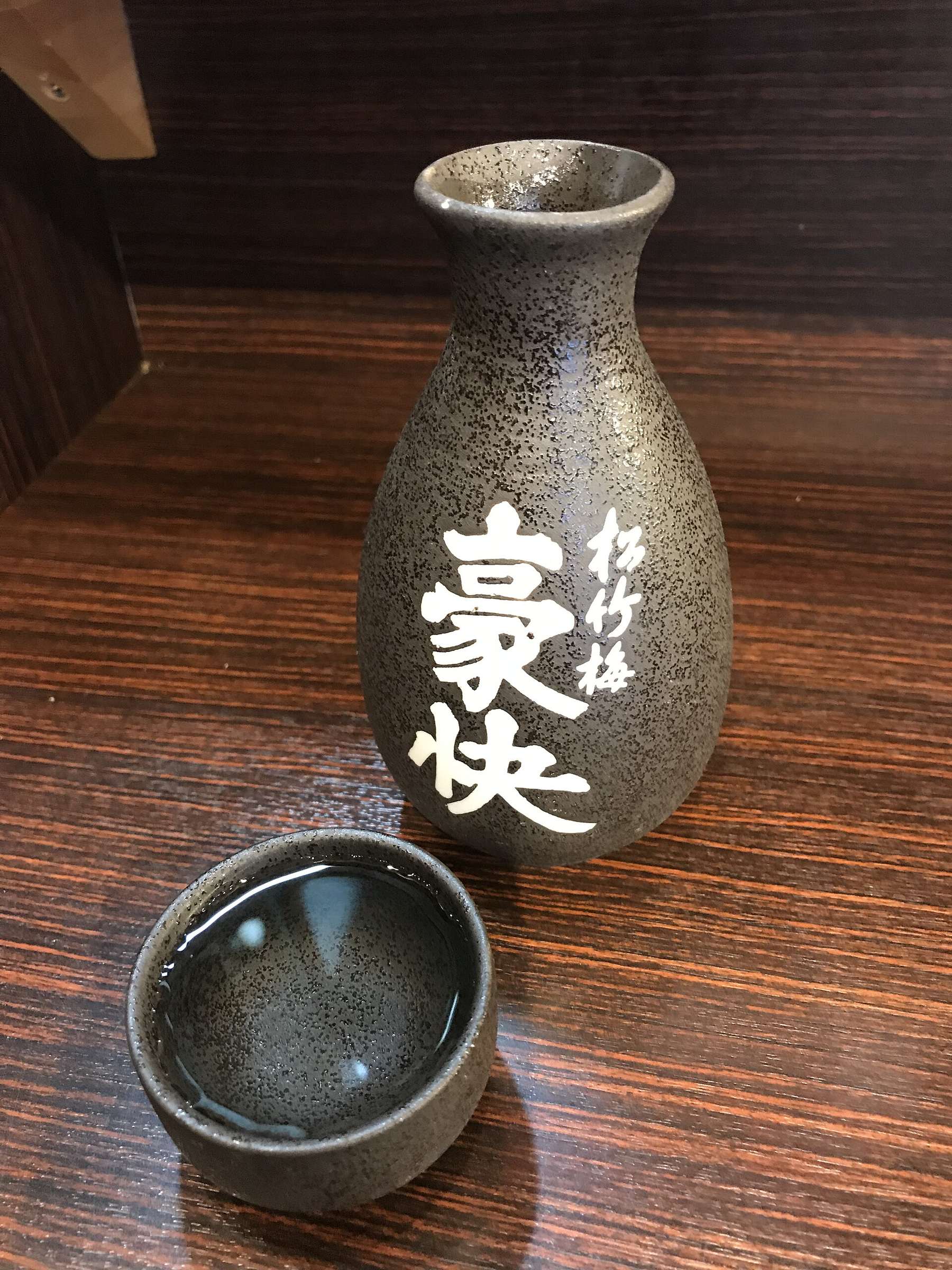
The June flight went into the fridge in the afternoon and came out cold, which was a default rather than a decision, and it is the one thing about that evening worth changing. Two of the six bottles carry a serving instruction from the brewery or the importer, and both instructions say to warm them.
Temperature is the biggest variable you control after choosing the bottle. The same sake at 41°F and at 104°F is not the same drink in any respect that matters, and the gap is wide enough to move a bottle several places down a scorecard.
What heat is doing to the glass
The Japan Sake and Shochu Makers Association publishes a guide to sake with the National Research Institute of Brewing, the state brewing laboratory founded in 1904, and it states the mechanism in one line. Warming causes the alcohol and the aroma compounds with a low boiling point to vaporize. That is why a warm glass smells like more than a cold one, and why a hot glass smells mostly of alcohol.
Taste moves on a different schedule from aroma. The same guide says temperature has little effect on our ability to sense acidity, while sweetness registers more strongly at temperatures close to body heat. That asymmetry is the entire argument for warming a junmai. Junmai tends to run low in sweetness and a little high in acid, so heat lifts the half of the balance that was short and leaves the other half roughly where it was.
Their numbers at both ends are the ones worth carrying around. Ginjo and namazake want around 46 to 50°F, since the fruit in a ginjo and the freshness in a nama are the first things to go when a glass warms up. Below about 41°F you stop being able to taste much of anything, so a bottle pulled from the back of a cold fridge is working against you. Warmed sake is normally taken to 108 to 113°F, and past that the alcohol comes forward and covers the aroma the brewer spent a month building.
The words a menu will use
Japanese names warm sake in five degree steps, and the guide lists five of them.
- Hinata-kan, 86°F, warmed in the sunshine.
- Hitohada-kan, 95°F, heated to body temperature.
- Nuru-kan, 104°F, heated to tepid.
- Jo-kan, 113°F, heated fairly warm.
- Atsu-kan, 122°F, heated hot.
Atsu-kan is the one printed on almost every American menu, and it sits at the top of that ladder, past the point where the guide says the alcohol starts masking everything else. A lot of people in this city formed their opinion of warm sake by ordering it. The opinion is really about 122°F rather than about warmth.
Cold has its own vocabulary, running from yuki-hie at about 41°F through hana-bie at 50°F to suzu-hie at 59°F. Those turn up on Japanese retail listings and brewery sheets far more than on menus here, which is a shame, because the difference between 41 and 59 is larger on the palate than the difference between two bottles.
How to warm a bottle without wrecking it
The method in the guide needs a saucepan and nothing else. Pour the sake into a small vessel, a ceramic tokkuri or a metal chirori, bring a pan of water to a boil, turn the heat off, and stand the vessel in the water for two or three minutes. Leaving the burner running is what overshoots. Stop short of the brim as well, since sake expands as it heats.
Microwaves are where two Japanese authorities disagree in print. The guide allows one, with the caveat that a tokkuri's narrow neck heats unevenly, and suggests warming in a straight-sided heatproof mug and pouring it across afterwards. The association's separate service manual ran the test and came out harder against it. Taking 200 ml to 122°F in a 500 W microwave failed on all four of the sake styles they evaluate, meaning the aroma or the flavour came out unbalanced against the original. The same volume brought to the same temperature by standing in just-boiled water passed on all four, and the standing time they recorded was two minutes thirty seconds.
Whichever way you get there, the temperature you hit is a moment rather than a setting. That service manual tracked warmed sake falling from 158°F to 95°F in about thirty five minutes in a 64°F room, which is a slide across four of the five named bands. Small pours are how you stay inside one, because what is left in the flask holds its heat better than a full glass does. That is the honest case for a small cup over a wine glass, and close to the only one, since a wine glass wins on aroma every time.
What this means for the bottle that finished fifth
Kurosawa Junmai Kimoto came fifth of six at 3.5. Skurnik Wines & Spirits, which carries it, writes on its own page that serving it chilled keeps it lean and acidic, and that gently heating it to 100°F or more brings out sweetness and chocolate notes. We served it chilled. One hundred degrees puts you between hitohada-kan and nuru-kan, at the gentle end of warm and nowhere near the atsu-kan a restaurant would hand you.
Hatsumago finished last at 2.0, the widest gap of the night, and it was the second kimoto in the flight. Its American importer, Pacific International Liquor, says to serve it chilled for clarity and elegance, or warm to reveal deeper umami and spice tones. Both kimoto bottles landed at the bottom of a cold flight. That reads less like two breweries failing on the same evening and more like one serving decision applied six times.
Okunomatsu Tokubetsu Junmai finished second and is the interesting case, because the recommendation changes depending on which side of the Pacific you read it. The brewery's own listing gives three ways to drink it, at room temperature, at 104°F and at 122°F, and says it can be enjoyed warmed. The same importer's American page for the same bottle says chilled or room temperature and stops. Nobody is being dishonest. Warm sake is a hard sell to an American buyer, so the instruction falls off somewhere between the brewery and the shelf, and the bottle arrives here quieter than it left.
There is a second problem with how the night was run, which is that nothing sat at room temperature either. The guide recommends 64 to 68°F for evaluating sake, on the grounds that it shows the subtle characteristics best and tires the palate least, and every glass we poured was well under that. Six bottles poured cold measures how six bottles behave cold. Calling the result a ranking of the bottles asks more of it than it can carry. All six scores and both kimoto arguments are on the score sheet, and the way out is a second flight with the same bottles poured warm and scored under the same rules described in how a blind tasting works.
Until that happens there is a cheap version anybody can run at home. Pour two glasses from one bottle, drink the first cold, and stand the second in a mug of hot tap water for a few minutes before drinking it. Most junmai sitting on a D.C. shelf will do something at 100°F that it will not do at 45°F, and finding out costs you a bottle you already own.
Written for Kasumi Club, a sake tasting and buying club in Washington, D.C. Every bottle we have poured, with its blind score and full specifications, is on the score sheet.
Send us a bottle and about twenty people will tell you the truth.
Kasumi Club pours everything blind. Breweries and importers use us to test the D.C. market, and every bottle we pour gets a page with its score, whether it wins or not.
How it works for breweries