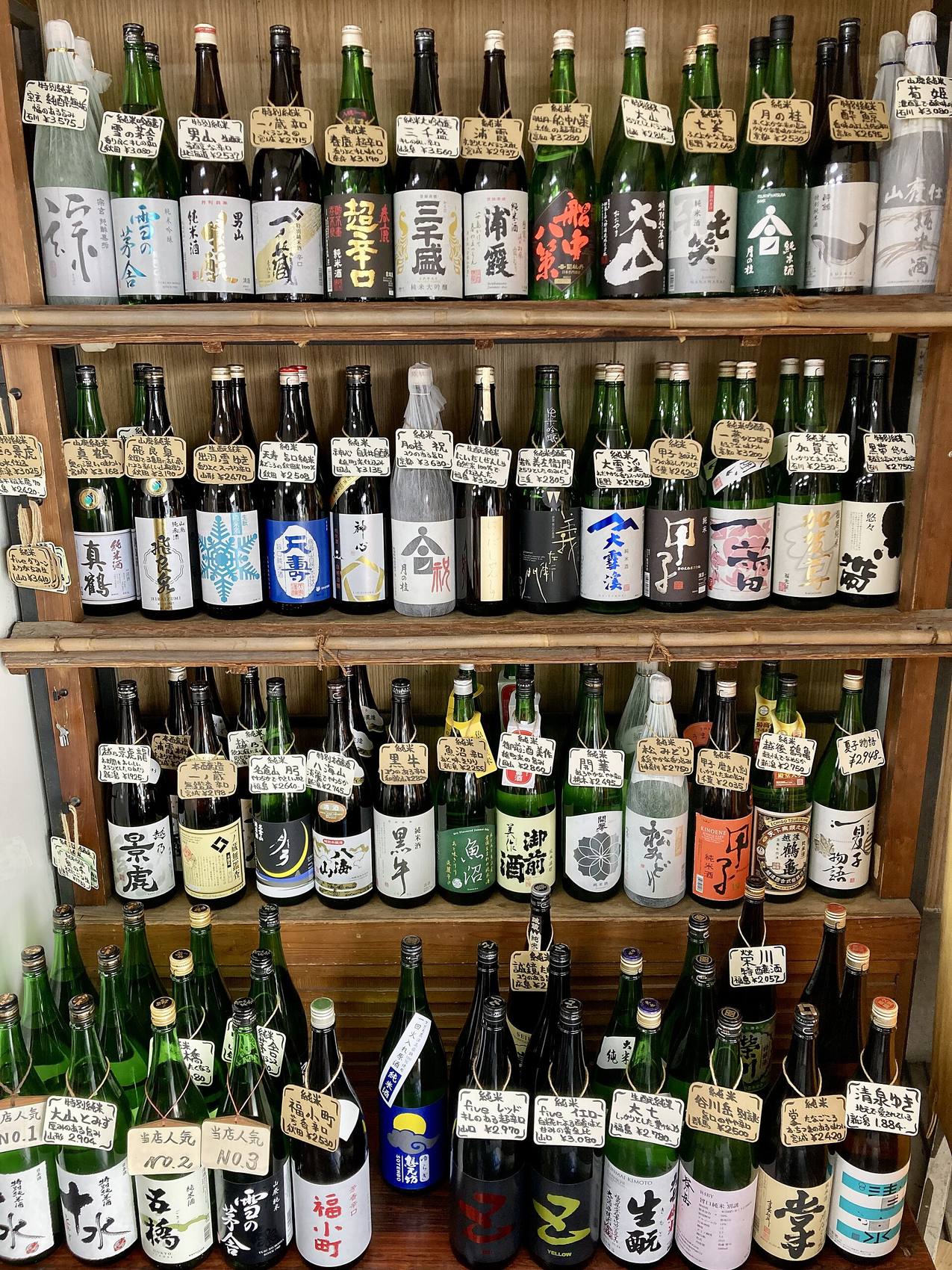
Look along the sake shelf in any D.C. shop that carries more than a dozen bottles and the prices climb in steps that follow the grade on the label. Junmai sits near the bottom, junmai ginjo a step up, junmai daiginjo at the top, and a few bottles past that cost more than several of the cheap ones put together. Some of that is marketing and some is scarcity. Most of it comes down to one number printed on the back, the milling ratio, and to what a brewery has to buy to hit it.
The grades are set in Japanese law. The Japan Sake and Shochu Makers Association's guide to sake lays them out. A ginjo has to be made from rice milled to 60 percent of its original weight or less, a daiginjo to 50 percent or less, and both have to be brewed by the ginjo method. Junmai in front of either means rice, koji and water with no distilled alcohol added. Ordinary sake, futsu-shu, is milled to around 70 percent on average, and the guide puts rice polished for eating at 92. If the vocabulary is new, how to read a sake label shows where each of these sits on a bottle.
The arithmetic of grinding rice away
The milling number is a weight. Sixty percent means that of every kilo of brown rice the brewery bought, 600 grams went on to be steamed and 400 grams came off the mill as bran. Run it the other way and it becomes a shopping list. To put one kilo of polished rice into a tank, a brewery milling to 70 percent buys about 1.4 kilos. At 50 percent it buys 2. At 23 percent it buys about 4.3, and at 18 percent about 5.6.
Now put a price on the rice. In July 2022 Asahi Shuzo, the brewery behind Dassai, announced it would pay 35,000 yen per 60 kilo bag for Yamadanishiki that passed its own inspection, and said the going market price was around 25,000 yen. At that market price the rice behind one kilo of polished rice comes to roughly 600 yen at 70 percent, 830 yen at 50 percent, 1,800 at 23 percent and 2,300 at 18 percent. Those figures are our arithmetic from Dassai's published price, and they leave out everything except the rice, but they show the shape of the ladder. Going from 60 percent, the ginjo line, to 18 percent multiplies the rice bill by more than three before anyone has steamed a grain.
The top of the ladder also needs rice that survives the mill. Dassai's announcement made the point that a large shinpaku, the starchy white core that makes a grain good for brewing, is fragile and not suited to high polishing, which is part of why it was offering more for rice that would hold together. What the shinpaku is, and why breweries pay for it, is covered in our post on sake rice.
What the mill costs in time
Milling to these levels is slow. Dassai's own account of making its 23 percent sake for New Year's Day 2000 describes the mill running for six days and six nights before the brewery asked for two more points, and says the final 2 percent took 24 hours alone. Every one of those hours is an hour the machine spends on one batch of rice and nothing else.
Tatenokawa, founded in 1832 in Sakata, Yamagata, has built its whole range at this end. Sakenomy, the Japanese brewery directory, describes it as the first brewery in Yamagata to make all of its sake junmai daiginjo. Its American importer, Mutual Trading, lists a Tatenokawa 18 milled to 18 percent and calls that the highest polishing ratio in Japan. Two Tatenokawa bottles are on their way to us from Mutual Trading for the October 24 flight. We do not yet know which two, and they will be poured blind like everything else.
The rest of the bill
Milling is the biggest lever but the association's guide lists four more parts of ginjo brewing, and each costs something. The guide prefers sake rice over table rice. The koji has to be grown in the tsukihaze style, where the mould grows in spots across the grain rather than covering it, and the toji controls the spores, water and temperature to get there. Fermentation runs at 12°C or below, which stretches it from the usual three to four weeks to four to five, so the same tank turns out fewer batches in a season. And the mash is pressed with limited pressure, which the guide compares to free-run wine.
The guide also states the conclusion in so many words in its section on milling. The lower the milling number, the higher the cost of producing the sake. What it says you get for the money is a balanced sake with a pronounced aroma, a smooth mouthfeel and a good aftertaste. That describes a style. Whether that style wins a room is a separate question.
What our six bottles say about it
The June flight had no daiginjo in it, and the milling numbers on the score sheet ran only from 58 to 65 percent. The winner, Momokawa Pearl, was the most heavily milled of the six at 58 percent, but it is a nigori brewed in Oregon, outside the Japanese grading law, and it won by a fifth of a point. Three bottles sat at 60 percent and finished second, third and last. Okunomatsu took second at 4.0 and Hatsumago took last at 2.0, from rice milled to the same number. The two at 65 percent finished fourth and fifth.
Six bottles prove nothing about a price ladder, and they were never meant to. What the spread does show is that the milling number predicts a style better than it predicts a score. A kimoto at 65 percent is chasing body and acidity, and grinding its rice down further would cost more and take away the thing it is for.
One more cost, added in the U.S.
A last line on the bill gets added after the bottle leaves Japan, and it follows the word junmai. The TTB, which collects federal alcohol tax, treats sake as beer for tax purposes. Imported sake that had brewer's alcohol or distilled spirits added at any stage is taxed at the distilled spirits rate instead, $13.50 per proof gallon. A daiginjo without the word junmai may contain added alcohol up to 10 percent of the weight of its polished rice, according to the association's guide. At full federal rates that comes to roughly 10 cents of tax on a 720 ml bottle of junmai and roughly 80 cents on a 720 ml bottle at 16 percent with alcohol added. Smaller producers can qualify for reduced rates, so the figure on a given bottle may be lower. Next to the rice it is small change, and when the club places a group order through a retailer, the two questions worth asking about any bottle are its milling number and its rice, because together they account for most of what the brewery paid to make it.
The ones we hear most
What is the difference between junmai ginjo and junmai daiginjo?
Milling. A ginjo must be made from rice polished to 60 percent of its original weight or less, and a daiginjo to 50 percent or less. Both are brewed by the ginjo method, and junmai means no distilled alcohol was added.
Why is daiginjo sake so expensive?
Mostly the rice. Milling to 50 percent means buying two kilos of rice for every kilo that goes into the tank, and the most extreme bottles are milled to 23 or 18 percent. Ginjo brewing also runs colder and longer, tying up a tank for four to five weeks instead of three to four.
How long does it take to polish sake rice?
It depends on the target. Dassai's account of its first 23 percent sake describes six days and six nights of milling, with the final 2 percent taking 24 hours on its own.
How is sake taxed in the United States?
The TTB treats sake as beer for tax purposes. Imported sake that had brewer's alcohol or distilled spirits added at any stage is taxed at the distilled spirits rate of $13.50 per proof gallon instead, so a junmai pays less federal tax than an otherwise similar sake with added alcohol.
Written for Kasumi Club, a sake tasting and buying club in Washington, D.C. Every bottle we have poured, with its blind score and full specifications, is on the score sheet, and the terms are defined in the glossary.
Send us a bottle and about twenty people will tell you the truth.
Kasumi Club pours everything blind. Breweries and importers use us to test the D.C. market, and every bottle we pour gets a page with its score, whether it wins or not.
How it works for breweries